


Commercial sign repair is a project decision, not simply a cosmetic fix. Facilities leaders, property managers, general contractors, and national sign companies need to understand the cause of failure, the risks at the site, and whether repair will restore dependable performance. A disciplined assessment can help protect visitors, maintain brand consistency, and coordinate work across stakeholders.
Request a commercial sign repair consultation
Quick answer: Start with a documented inspection, identify structural, electrical, environmental, and operational issues, then compare a technically sound repair with replacement. Confirm applicable approvals, access needs, outage windows, and responsibilities before scheduling field work.
What should commercial sign repair accomplish?
A repair should address the underlying condition and return the sign to an appropriate, safe operating state. Replacing a failed component without understanding why it failed can lead to recurring service calls. A complete project brief should define the affected sign, observed symptoms, urgency, site constraints, and the business function that must be restored.
First, record what is visible: dark or flickering illumination, damaged faces, loose components, water intrusion, corrosion, impact damage, or a sign that no longer presents the approved brand. Photograph the sign from several angles and note when the problem began. Do not climb on or open energized equipment to investigate. Keep people away from any visibly unstable component and arrange a qualified assessment.
Then establish the operational priority. A damaged sign at a busy entrance may affect navigation and create a safety concern. A failure at one site in a multi-location program may also require a consistent response plan for similar equipment elsewhere. For work involving illuminated displays, review the project scope for electrical coordination through the relevant LED signage capabilities.
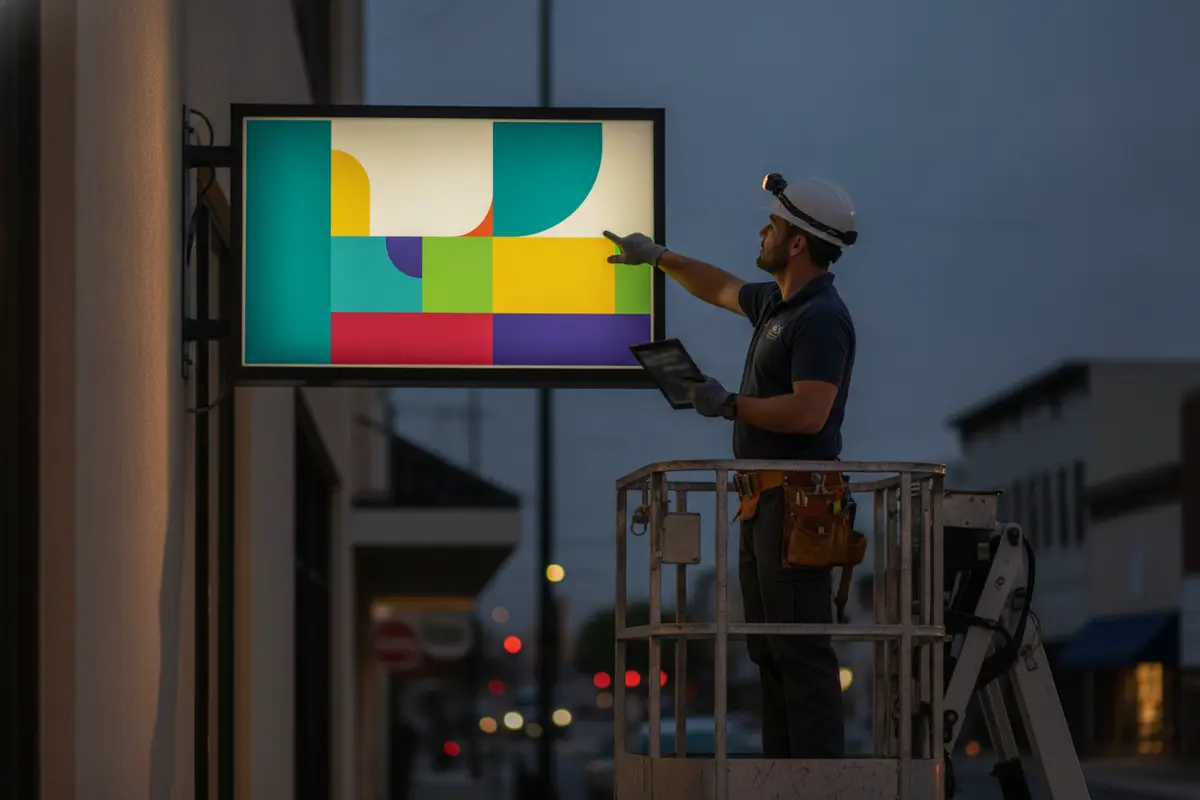
How should the team assess the sign before choosing a fix?
Diagnosis should separate symptoms from causes. A dark display could involve a power supply, wiring, controls, a failed module, or a broader electrical issue. A loose panel may indicate fastener failure, water damage, substrate deterioration, or movement in the supporting structure. The assessment should identify the affected components and note whether the sign can be safely accessed and returned to service.
- Structure and attachment: Check visible movement, corrosion, cracked supports, fasteners, and the condition of the mounting surface. Structural concerns may require engineering review before work proceeds.
- Electrical systems: Document outages, inconsistent illumination, exposed wiring, and control issues. Electrical diagnosis and repair should be assigned to qualified personnel.
- Sign face and materials: Look for cracking, fading, delamination, water entry, or damage that obscures the message or brand.
- Controls and digital components: Record error messages, display behavior, and any recent changes to programming or connectivity.
- Site and access: Note traffic, pedestrian routes, working height, landscaping, operating hours, and any restrictions on lift or equipment placement.
For large or elevated signs, a field visit may be needed to verify conditions that cannot be established from photographs. The team should document assumptions and identify any concealed conditions that could affect scope. When the work requires coordinated field execution, review the provider's commercial sign installation approach.
What evidence should an assessment record?
A useful condition record connects each observed symptom to its location and operational effect. Include dated photographs, a simple site sketch, sign identification or asset number, and notes about whether the problem is constant or intermittent. For illumination issues, record which sections are out and whether the behavior changes over time. For structural concerns, photograph the visible connection points from a safe position and flag areas that need closer inspection by qualified personnel.
Keep observations separate from conclusions. A photograph may show water staining, for example, but it does not establish the path of water entry or the extent of concealed damage. Ask the assessor to distinguish confirmed conditions from items that require access, testing, engineering review, or disassembly. This makes the repair recommendation easier to evaluate and helps prevent an estimate from being mistaken for a complete diagnosis.
When is repair the right choice, and when should you consider replacement?
Repair may be appropriate when the main structure remains suitable, the sign can be restored with compatible components, and the result will meet current project requirements. Replacement deserves consideration when damage is extensive, essential components are obsolete or unavailable, structural condition is uncertain, or repeated repairs have not resolved the root cause.
| Decision factor | Repair may fit when | Replacement may fit when |
|---|---|---|
| Structural condition | Supports and attachment points are assessed as serviceable | Damage or deterioration affects the supporting system |
| Parts and compatibility | Compatible components are available and can be integrated | Critical components cannot be supported or matched |
| Performance | A defined fault can be corrected and tested | Recurring failures indicate broader system issues |
| Brand and site needs | The existing sign still meets the intended identity and function | Updated requirements call for a different sign system |
| Approvals and scope | The proposed repair can proceed under applicable approvals | Changed dimensions, location, or design call for a new review |
This comparison is a planning aid, not a substitute for inspection or jurisdictional review. A repair that changes dimensions, illumination, location, or structural loading may need additional review. Keep the decision grounded in verified site conditions, equipment compatibility, and the intended service life rather than a quick visual patch.
- Ask for the specific failure cause and proposed corrective work.
- Clarify which components will be reused, replaced, tested, or documented.
- Request a description of assumptions, access requirements, and exclusions.
- Compare the repair plan with a replacement option when condition or compatibility is uncertain.
How should a team compare the two paths?
Compare scope, risk, disruption, and expected serviceability rather than looking only at the immediate work description. A repair proposal should say what condition it corrects, what components remain in place, how the work will be tested, and what uncertainty remains. A replacement proposal should clarify what existing structure or electrical infrastructure can be retained, what approvals may be needed, and how removal and installation affect the property.
For either path, ask what completion evidence will be provided. This may include photographs, a record of parts changed, test results, and a list of remaining conditions. For a portfolio of properties, consistent reporting makes it easier to compare recurring issues and decide whether a site-specific repair remains sensible or a broader standard should be reviewed.
What permitting and coordination issues should be resolved?
Sign requirements vary by location, property, sign type, and scope of work. Before work begins, verify requirements with the authority having jurisdiction and the property owner or manager. Do not assume that a repair is automatically exempt from review, particularly if it changes the sign's size, placement, lighting, structure, or electrical system.
For example, the City of San Antonio sign and billboard permit guidance states that certain freestanding signs, electric signs, and larger signs require sign plan review and a permit. That is a local example, not a rule for every jurisdiction. Confirm applicable requirements for the actual site before defining schedule or scope.
Coordinate the work among property management, facilities, construction, electrical teams, the sign provider, and any tenant or brand representatives. Agree on who obtains approvals, who provides site access, who manages traffic or pedestrian controls, and who signs off on completion. For multi-site work, assign a project manager and maintain a consistent record of site-specific conditions and approvals.
For an illuminated sign, set an outage window and communicate it to affected occupants. For elevated work, confirm safe access, equipment staging, weather constraints, and protection of the public. If a repair involves a digital display, coordinate configuration and testing as well as physical work. Carolina Signs and Wonders offers commercial digital signage as part of its broader signage capabilities.
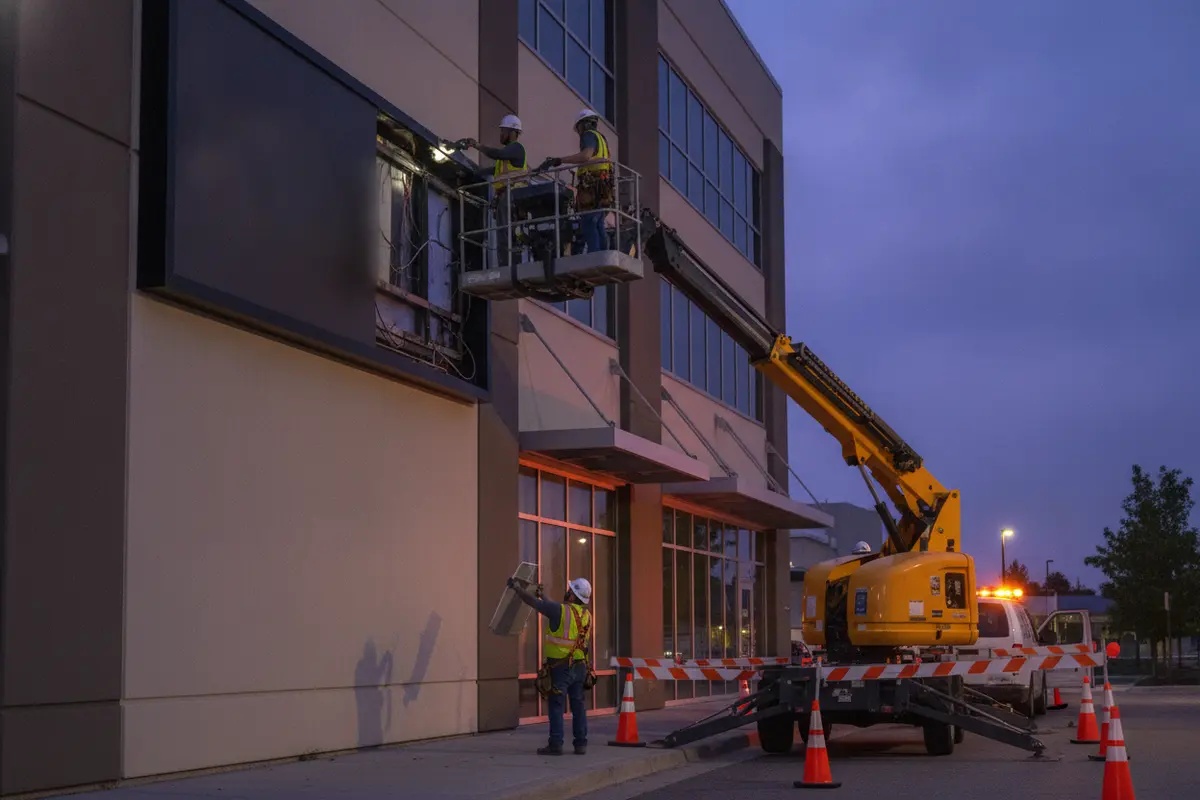
What should the work sequence cover?
Set milestones in an order that reflects dependencies. First document existing conditions and confirm the intended scope. Next, verify approvals, engineering needs, electrical responsibilities, access arrangements, and any procurement or property review. Then schedule parts, equipment, outage windows, and field personnel against site operating hours. For multiple locations, group work by geography only when doing so does not bypass site-specific approvals or verification.
Before mobilization, circulate a short work plan with dates, contacts, access instructions, work-area limits, and escalation contacts. Identify who can approve a change if concealed conditions differ from the assessment. At closeout, record what was completed, what was tested, any deferred work, and who accepted the result. This basic sequence prevents an apparently small field task from creating avoidable coordination gaps.
How can a multi-location rollout stay controlled?
Use a central asset list and repeatable reporting fields, but do not treat every sign as identical. Record location, sign type, observed condition, approval status, access requirements, scope, schedule, and closeout status for each site. A central project manager can track decisions and flag exceptions for review before crews are dispatched.
Where brand standards or approved components apply across locations, give field teams the current specifications and a named approver for deviations. Capture site photographs before and after work, and record any variance in materials, mounting conditions, or access. This lets the organization protect a consistent appearance while recognizing that local property conditions and approval processes can differ.
How do materials and implementation affect durability?
A durable repair uses components that suit the sign's design, exposure, and operating conditions. The right choice depends on the existing assembly and verified failure cause. A mismatch in material, finish, electrical component, or mounting method can affect appearance and performance, even if the sign looks complete at handover.
- Match the system: Confirm compatibility with the existing face, frame, lighting, controls, and mounting method.
- Address exposure: Consider sunlight, moisture, wind, temperature changes, and other conditions at the site.
- Protect brand consistency: Verify colors, letter forms, finishes, illumination, and message against approved brand standards.
- Plan for serviceability: Identify components that may need future access and keep records of installed parts and test results.
- Inspect the completed work: Check attachment, finish, illumination, controls, and the site cleanup before closeout.
These considerations are especially important across multiple locations. Standardize approved specifications where possible, but document site differences rather than assuming every installation is identical. A complete project should leave the owner with a clear account of work performed and any follow-up items.
Which implementation details deserve special attention?
Confirm how the repaired area will be sealed, finished, attached, and accessed in the future. Where illumination is involved, verify the replacement component's compatibility with the existing system and specify how operation will be checked after installation. A repair should not conceal a damaged substrate or leave a new component dependent on a compromised connection.
Appearance is part of the acceptance criteria, not an afterthought. Compare repaired faces, colors, illumination, and letter forms with approved brand references under relevant viewing conditions. If a perfectly identical match is not feasible because of age or material availability, document the proposed alternative and obtain approval before fabrication or installation.
Closeout records also support future maintenance. Keep the final scope, component information when available, testing notes, photographs, and any access or care recommendations with the property's sign records. For a national program, use a common record format and note local exceptions. This avoids repeated diagnosis from scratch when another team takes over the asset.
What should a project brief include?
A concise brief helps a sign partner provide a grounded scope and coordinate the right people. Include the sign location, type, dimensions if known, photos, observed symptoms, operating impact, access constraints, desired completion window, and available drawings or prior service records. Identify the property contact, decision-maker, and any brand or construction approvals.
For a multi-location or construction program, add a site list, rollout priorities, local contacts, standard specifications, and a process for recording exceptions. State whether the request is assessment only, repair, or a comparison of repair and replacement. A qualified partner can then confirm what needs field verification and explain the sequence for approvals, engineering, fabrication, electrical coordination, and installation.
Carolina Signs and Wonders positions its work around integrated design, permitting, engineering, fabrication, installation, and ongoing service. Review the company's signage services and project portfolio when evaluating fit for a complex commercial scope.
What questions can sharpen a repair request?
- What is the operational impact, and is the affected sign necessary for visitor orientation or site identification?
- When was the issue first noticed, and has it changed or recurred?
- Are there current drawings, specifications, previous inspection notes, or repair records?
- Who approves design, materials, access, outage timing, and any change in scope?
- What documentation is needed for procurement, property records, or a multi-site program?
Answering these questions in advance does not replace a professional assessment. It does help define the decision-makers and information needed to move from initial report to an approved, coordinated scope.
How can you select a durable repair partner?
Choose a provider based on its ability to diagnose the issue, manage the work safely, and account for the complete project. Ask how the team will evaluate structure and electrical components, determine permit needs, coordinate access, protect brand standards, and document the final work. For a multi-site requirement, ask how it manages local permitting, installation schedules, communication, and site-specific reporting.
One accountable partner can reduce handoffs among design, permitting, fabrication, electrical coordination, installation, and service. Confirm the proposed scope, responsibilities, schedule assumptions, and closeout documentation in writing. For more background on the organization, visit the company overview and discuss the project requirements directly.
What should you verify before approving a proposal?
Check that the proposal identifies the specific sign and failure being addressed, separates inspection findings from assumptions, and describes the work in enough detail for stakeholders to approve it. Confirm who is responsible for permits, engineering or electrical coordination, site protection, access equipment, and any third-party approvals. Where another trade or property team has a dependency, name the handoff and the person who will confirm readiness.
Ask how changes will be handled if crews uncover conditions that differ from the initial review. A clear process should pause work where needed, document the new condition, explain the effect on scope or schedule, and obtain approval from the designated decision-maker. This is particularly important for complex sites where an unplanned change can affect adjacent operations or multiple stakeholders.
Finally, define acceptance before mobilization. Confirm what must be working, how appearance will be reviewed, what test or inspection records will be supplied, and who will sign off. A shared closeout checklist gives facilities, property, procurement, and brand teams a common basis for confirming completion.
Discuss your commercial sign repair project
Frequently Asked Questions
Can a damaged illuminated sign be repaired without replacing it?
Sometimes. The answer depends on the condition of the structure, electrical system, face, and available compatible components. A qualified assessment should identify the cause and confirm whether repair can restore dependable operation.
Does commercial sign repair always require a permit?
No single answer applies everywhere. Requirements depend on the jurisdiction and the work being done. Check with the local authority and property owner before scheduling, especially when the scope changes the sign's structure, size, location, or electrical system.
What information should I provide to request an assessment?
Share the address, sign type and location, clear photos, symptoms, timing, access constraints, and any prior drawings or service records. For multiple sites, include a location list and a contact for each property.
How can a multi-location team keep repairs consistent?
Use shared specifications, a defined approval path, site-by-site records, and a central project contact. Record any local differences and verify each site before assuming the same repair scope applies everywhere.
Ready to plan commercial sign repair?
Start with a clear diagnosis, verify local requirements, and choose a repair scope that addresses the cause rather than only the visible symptom. A coordinated project plan helps protect people, brand consistency, and long-term sign performance.


