


A business LED sign can do more than identify a facility. For a school, church, municipality, healthcare organization, or multi-location brand, it can support recognition, communicate timely information, and create a consistent public-facing presence. The best result comes from planning the sign as part of the property, electrical system, brand standards, and long-term service plan. This guide explains how to plan a business LED sign for a commercial signage project, from the first site review through installation and maintenance.
What should a business LED sign accomplish?
Start by defining the job the sign must perform. A sign near a busy road may need strong legibility at distance. A campus sign may need to identify the property while sharing changing messages. A corporate sign may need to express brand standards consistently at many locations. These are related goals, but they can lead to different display sizes, mounting methods, brightness controls, and content plans.
A useful project brief answers four questions:
- Who needs to see the sign? Identify drivers, pedestrians, visitors, employees, students, patients, residents, or event attendees.
- Where will they see it? Record approach direction, viewing distance, traffic speed, sightlines, landscaping, nearby buildings, and seasonal obstructions.
- What must the sign communicate? Separate permanent identification from messages that will change by time, event, season, or operational need.
- What must remain consistent? Establish approved logos, colors, type treatments, message length, display behavior, and accessibility expectations before production.
These decisions help the team determine whether the project needs illuminated channel letters, a digital message center, an LED component integrated into a monument or pylon sign, or a coordinated combination. Carolina Signs and Wonders provides custom business signs for projects where visibility, durability, and brand presentation must work together.
How should the site be assessed before design?
A site assessment turns a general sign request into an executable plan. It should consider the sign face, supporting structure, power, access, visibility, permitting, and installation conditions. For an existing property, document the current sign, foundation, wiring, disconnects, controls, and any damage or changes since the original installation. For new construction, coordinate the sign with the building elevation, civil plans, utilities, landscaping, and construction schedule.
Ask the project team to document the following:
- Available mounting surfaces and structural attachment points
- Foundation or footing conditions for freestanding signs
- Electrical service location, voltage, circuit capacity, and disconnect access
- Expected viewing distances and sightline conflicts
- Lighting conditions during operating hours and after dark
- Lift, crane, truck, staging, and site access requirements
- Property setbacks, easements, landscaping, utilities, and pedestrian circulation
- Local sign regulations, zoning requirements, permit forms, and review timelines
Do not treat a photograph from the street as a complete survey. A qualified sign partner may need field measurements, electrical review, structural calculations, and coordination with the owner, architect, general contractor, utility provider, and local authority. The commercial sign installation plan should be based on actual conditions rather than assumptions.

Which business LED sign options should the team compare?
LED is a lighting technology, not a single sign type. The right configuration depends on the message, scale, environment, viewing distance, and service requirements. Compare options by function instead of selecting a display only because it appears bright in a sample image.
| Option | Best fit | Planning considerations | Service focus |
|---|---|---|---|
| Illuminated channel letters | Building identification and permanent brand presentation | Wall structure, raceway, electrical routing, letter size, and nighttime legibility | Power supplies, lighting performance, seals, and individual letter access |
| LED message center | Changing announcements, schedules, alerts, and event information | Content governance, viewing distance, brightness control, connectivity, and local approvals | Controller, software, network access, pixel performance, and content support |
| LED-integrated monument sign | Campus, healthcare, municipal, church, and multi-tenant identification | Foundation, cabinet proportions, landscape relationship, message hierarchy, and service access | Cabinet seals, modules, power components, display controls, and site access |
| LED-integrated pylon sign | High-visibility properties requiring elevation above site obstructions | Wind loads, foundation, structural engineering, tenant hierarchy, and installation logistics | Elevated access, cabinet components, wiring, and coordinated inspection |
A comparison should also cover how the sign will age. Ask about color consistency, weather exposure, drainage, access panels, replacement components, controls, and the expected process for a service call. A visually impressive design that cannot be safely accessed or efficiently repaired may create avoidable operational risk.
For properties that need a coordinated exterior identity, review related monument sign solutions and pylon and pole signs early. The supporting structure and sign face should be designed together rather than treated as separate purchases.
How do materials and construction affect durability?
Materials should be selected for the environment, scale, visual standard, and maintenance plan. Exterior signs face sun, rain, temperature changes, wind, dust, insects, and occasional impact. The enclosure, face, trim, fasteners, coatings, seals, and internal components all contribute to service life.
During design review, ask:
- Which face and cabinet materials fit the exposure and desired appearance?
- How will water drain from the enclosure and prevent accumulation?
- How will the design manage thermal conditions around LED components and power supplies?
- Can technicians reach components without removing unrelated sign elements?
- Are replacement modules and electrical components documented for future service?
- Will the finish and colors remain consistent with the brand standards across locations?
- Does the structure account for attachment loads, wind conditions, and the completed sign weight?
For a multi-location organization, document approved materials and construction details in a repeatable specification. This gives facilities and procurement teams a reference when sites differ and helps prevent substitutions that change appearance or service requirements. It also makes quality review more practical because the team can compare each installation against a defined standard.
What should the message and content plan include?
A business LED sign is part of a communication system when it displays changing content. Establish who can approve, schedule, publish, and remove messages. Decide which information is permanent, which is time-sensitive, and which should never appear without review.
Keep messages readable by considering character count, contrast, display size, viewing distance, transition speed, and time on screen. A sign beside a roadway usually needs a simpler message than a display viewed by pedestrians entering a campus. Use a content calendar for recurring announcements, seasonal events, emergency notices, and operational updates.
Content governance matters across a portfolio. A corporate, school, or municipal team may need multiple users with different permissions. Define account ownership, password management, network responsibility, approval thresholds, and backup procedures. If a display depends on connectivity, identify what happens when the network is unavailable. The sign should have a clear fallback behavior rather than becoming unpredictable or blank without explanation.
When a project includes interior directories, room identification, or accessible wayfinding, coordinate the exterior LED sign with the broader package. Carolina Signs and Wonders offers ADA and wayfinding signage to help teams plan a consistent experience from the property entrance through the building.
Which approvals and electrical details should be settled early?
Permitting is a project activity, not a final administrative step. Requirements can vary by jurisdiction, property type, zoning district, historic status, sign size, illumination, electronic messaging, and proximity to roads or other regulated areas. Confirm the applicable authority and submission requirements before the design is finalized.
The approval package may need scaled drawings, elevations, site plans, structural information, electrical details, property authorization, photographs, and manufacturer information. The team should also identify whether a separate electrical permit, inspection, or utility coordination is needed. A permit path that is not confirmed early can affect the sign dimensions, foundation, schedule, and installation method.
For accessibility-related elements, consult the applicable requirements and project standards. The U.S. Department of Justice guidance for businesses provides a useful starting point for understanding accessibility responsibilities. It does not replace project-specific review, local requirements, or professional judgment.
Assign responsibility for every approval. The owner may provide property authorization, the design team may prepare drawings, the sign manufacturer may provide engineering documents, and the installer may coordinate site access and inspections. A written responsibility matrix reduces the chance that a permit, utility disconnect, inspection, or landlord approval is assumed but not assigned.
How should installation be coordinated?
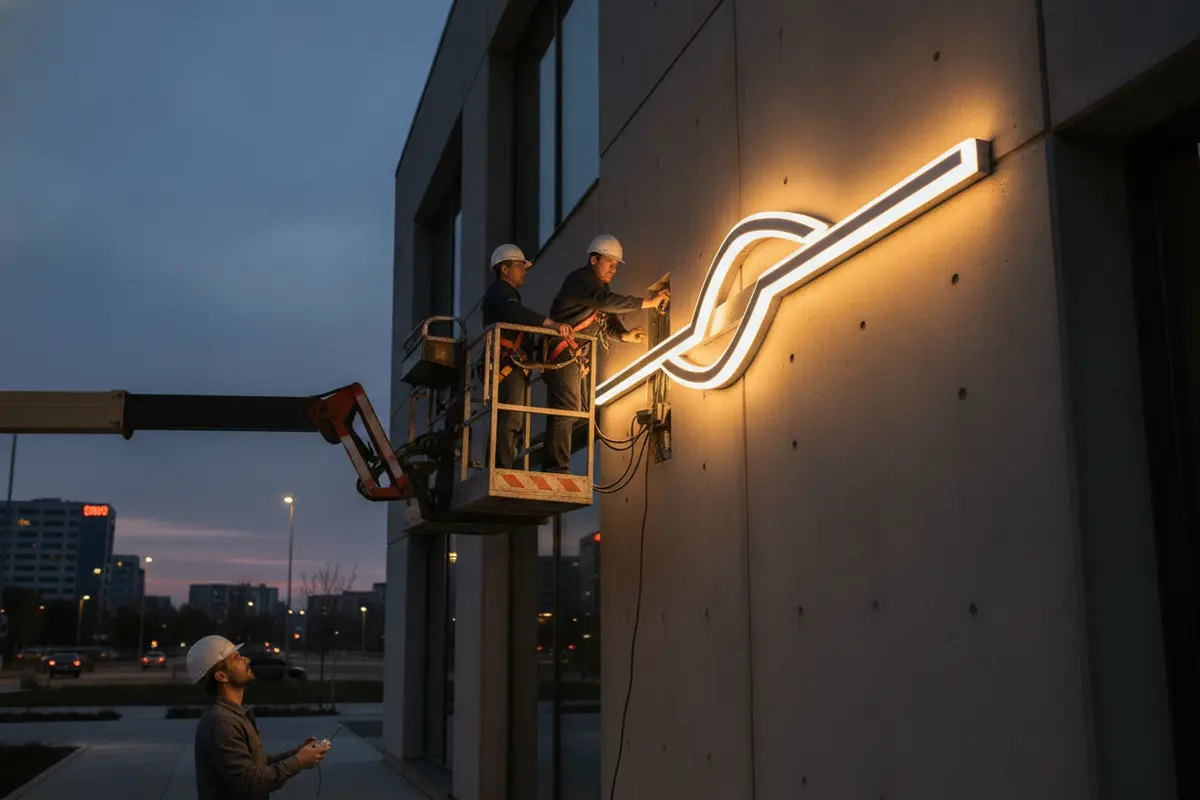
Installation planning should begin while the sign is being designed. Confirm the work window, site contact, access route, staging area, lift or crane needs, traffic control, pedestrian protection, weather limitations, and restoration requirements. On an active campus, healthcare property, retail site, or municipal facility, the installation plan may need to protect daily operations and coordinate with several departments.
A strong installation sequence commonly includes:
- Confirm approved drawings, permits, field dimensions, and site conditions.
- Coordinate fabrication, electrical components, structural elements, and delivery timing.
- Verify footing, wall, or support readiness before equipment is dispatched.
- Establish the work area, access controls, safety plan, and site communication process.
- Install the structure, sign components, wiring, controls, and required weather protection.
- Test illumination, message functions, timers, controls, and nighttime appearance.
- Complete inspection, punch-list corrections, closeout documentation, and owner training.
When an organization has several locations, use a dedicated project manager and a repeatable closeout process. Each site should have a record of approved drawings, permits, photographs, electrical information, control access, service contacts, and any field changes. That documentation supports future repairs and helps the facilities team manage the portfolio.
How can a multi-location organization protect brand consistency?
Multi-location programs need more than a master logo file. Create a sign standard that describes dimensions, proportions, colors, illumination, materials, mounting, message rules, clear space, and acceptable adaptations. Then identify which conditions can vary by site, such as setbacks, building elevations, local regulations, utilities, or landlord criteria.
A central standard should be paired with a site-specific survey. Applying one drawing to every property can create conflicts with local approvals or existing construction. A better process preserves the approved brand experience while allowing the engineering and permitting package to respond to each location.
Use a program-level schedule with site-level milestones. Track survey completion, design approval, permit submission, permit receipt, fabrication release, site readiness, installation, inspection, and closeout. This gives procurement, facilities, marketing, construction, and finance teams a shared view of progress.
For a broader portfolio, the national sign installation partner program describes a model for coordinating work across multiple United States locations. National sign companies and brand teams should look for dedicated permitting support, installation management, clear project communication, and documented closeout rather than treating each site as an isolated order.
What service plan should be included after installation?
Define service before the sign is installed. The plan should identify who receives service requests, how issues are diagnosed, what information the owner must provide, and how site access will be arranged. For digital displays, include controller access, software ownership, network contacts, content permissions, and backup procedures. For illuminated signs, document circuits, disconnects, power supplies, modules, timers, and inspection records.
Ask the sign partner how service work will be documented. Useful records include the original drawings, as-built changes, component specifications, photographs, permit details, test results, and a history of repairs. A facilities team can respond more effectively when this information is available without reconstructing the project from scratch.
Periodic review can identify issues before they become visible failures. Inspect cabinet conditions, fasteners, seals, wiring, brightness, color consistency, controls, and surrounding vegetation. Any inspection interval should reflect the sign type, exposure, operating demands, and owner requirements. The goal is dependable communication and identification, not simply a one-time installation.
How should you select a partner for a complex business LED sign?
Compare partners on the full project, not only on a rendering or initial proposal. A premium commercial sign project may involve design, structural engineering, electrical coordination, fabrication, permitting, installation, testing, and service. Single-vendor accountability can reduce handoffs, but only when the partner has the capabilities, communication process, and documentation to manage them.
Use these questions in a qualification discussion:
- Can the partner manage design, permitting, fabrication, installation, and service as one coordinated project?
- How are structural and electrical requirements reviewed?
- Who is responsible for permits, inspections, site coordination, and closeout?
- How does the team handle multiple locations with different jurisdictions and site conditions?
- What information will be supplied to facilities and procurement teams?
- How are schedule changes, field conditions, and approvals communicated?
- What service process applies after the sign is energized?
- Can the proposed materials and components support the intended environment and maintenance plan?
Carolina Signs and Wonders positions its work around design, engineering, manufacturing, electrical coordination, installation, and long-term service for complex signage programs. Review the signage services available to your project, then compare the proposed scope with your internal requirements. The custom sign portfolio can also help a project team discuss the level of finish, scale, and coordination it expects.
Request a consultation for your business LED sign project
Frequently Asked Questions
What is the first step in planning a business LED sign?
Define the sign's audience, viewing conditions, message purpose, location, operating schedule, and brand requirements. Then arrange a site assessment that covers structure, power, access, visibility, and approvals.
Does an LED sign always use changing messages?
No. LED lighting can illuminate permanent channel letters, cabinet signs, monument signs, or pylon signs. A digital message center adds changing content, controls, and content governance, but it is only one type of LED sign project.
Why should permitting be considered before fabrication?
Local requirements can affect sign dimensions, placement, illumination, foundation design, and electrical work. Confirming the approval path early helps prevent redesign, schedule disruption, and installation delays.
What should a facilities team receive at project closeout?
Request approved drawings, as-built information, permits, inspection records, component details, control credentials, photographs, testing results, service contacts, and owner training. These records support future maintenance and portfolio management.
How can a multi-location brand maintain consistent signs?
Use a central brand and construction standard, then complete a site-specific survey and approval package for each property. Track each location through design, permitting, fabrication, installation, inspection, and closeout.
How do you move from planning to a quote?
Prepare the project brief, site information, brand standards, desired message functions, target locations, schedule, and service expectations before requesting a quote. A qualified partner can use that information to identify engineering, permitting, fabrication, installation, and long-term service requirements. For a consultation-based project review, request a free sign quote from Carolina Signs and Wonders.
A well-planned business LED sign supports visibility, communication, and reliable operation because the sign is designed as part of the complete property and service program.


